
If you import goods from China, hold on tight. In mid-September, two opposite news stories hit, both affecting your profits. One came from Brussels, where the EU is quietly taking notes; the other from Ottawa, where Canada just tore up its rulebook. Let's break down this trade showpiece.
Act One: The EU's notebook and 134% question mark
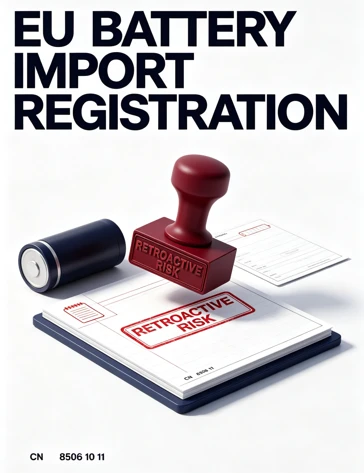
On September 15th, the European Commission issued the implementing regulation (EU) 2026/2049, imposing import registration on certain alkaline manganese dioxide batteries originating from China. The registration takes effect on September 16th and lasts for nine months until mid-June 2027.
"Import registration" sounds harmless. But the details are: The EU customs will now record each batch of these batteries imported. If the ongoing anti-dumping investigation eventually determines to impose taxes, the goods imported during the registration period may be retroactively taxed. Put simply: No extra payment today, but a bill may arrive tomorrow.
Being targeted product is cylindrical alkaline manganese dioxide battery ( HS code CN 8506 10, 11). The "damage elimination level" claimed by the complainant is as high as 134%. This is not the final tax rate; it's just a price offer. But just this number alone is enough to keep European importers awake at night.
What it means to you:
• There is no additional surcharge at present, but there is a hidden concern of retroactive taxation.
• Communicate with your Chinese suppliers: Should you ship earlier? Can the price be locked in?
• Keep all customs clearance documents. If Brussels comes to check, you must have the evidence.
Further reading:
EU Customs New Regulations 2026: What Impact Will They Have on Your Imports from China?
Act Two: Canada's "Let it be" moment and 0% tariff
While the EU is busy taking notes, Canada took a 180-degree turn.
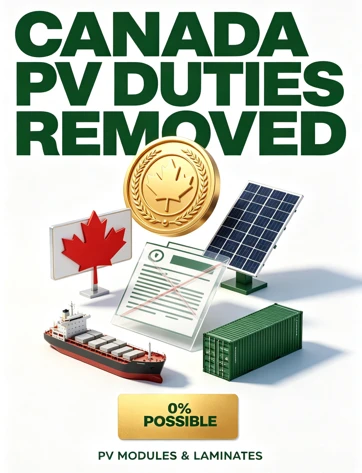
On September 17th, the Canadian International Trade Tribunal terminated the anti-dumping and anti-subsidy sunset review on Chinese photovoltaic modules and laminates, and revoked the relevant tariff orders.
Translation: Anti-dumping and anti-subsidy tariffs are gone. If your products meet Canada's most-favored-nation 0% tariff and have no other additional tariffs, the import tariff may drop to 0%.
Just like Canada looked at the documents and said, "Forget it, let it be." The surprise comes suddenly, but don't rush to open champagne - verify first.
What it means to you:
• The landed cost of Chinese photovoltaic modules may significantly decrease.
• You can renegotiate with suppliers, or increase the purchase volume.
• But don't assume: Confirm that your products are indeed within the scope of the cancellation. Check the HS code, origin, and specifications.
Contact our logistics expert to learn more about regulations for shipping from China to your country: sales09@senghorlogistics.com
Act Three: Why is it both harsh and lenient?
Global trade policies are not monolithic. Different products, different markets, different political considerations. The EU is protecting its domestic battery industry. Canada relaxed the restrictions on photovoltaic products, mostly due to its own energy transition needs and supply chain realities.
For importers, the conclusion is clear: You can no longer treat the tariff risk as a one-size-fits-all issue. You have to become your own supply chain policy analyst.
Importer Action List
1. Classify products - Compare your HS codes and official announcements one by one. Don't guess.
2. Talk to suppliers - Discuss the risk of retroactive taxation. Can you share or adjust the price?
3. Review contracts - Clearly define who is responsible for additional tariffs or retroactive taxes. Avoid post-event disputes.
4. Adjust shipping schedule - For EU batteries: Consider shipping before potential taxation. For Canadian photovoltaic: Consider increasing the order volume.
5. Keep an eye on things - Investigations and sunset reviews may drag on for several months. Subscribe to official bulletins or find a freight forwarder who tracks policies.
Epilogue: Amidst tariff changes, logistics is the surest pivot point
Policies will change, tax rates will adjust, but goods will eventually cross the ocean and reach your hands. In this uncertain trading environment, a reliable logistics partner can help you stay on track - we not only handle the transportation, but also help you interpret the market trends, avoid risks, and optimize shipping routes.
About author: Vilien Wu
Logistics sales of Shenzhen Senghor Sea & Air Logistics Co., Ltd.
We have been deeply involved in traditional door-to-door services for sea and air freight in markets such as Europe, the United States, Canada, and Australia. We have rich practical experience in consolidating shipments and integrating shipments from multiple suppliers.
Since entering the industry, we have come into contact with many small and medium-sized importers. We have found that many foreign trade practitioners have only a partial understanding of the logistics process, and most of their experience is accumulated from lessons. Therefore, we decided to share some real shipping cases and logistics knowledge to help more foreign trade practitioners avoid more pitfalls in the shipping process.
Whether a shipment can be successfully dispatched depends on the control and prediction ability of the freight forwarder at each stage. Choosing a reliable freight forwarder is very important, but as a foreign trade practitioner, having some knowledge of logistics can help you make better judgments and screenings.
Welcome friends with shipping needs or logistics problems to communicate at any time. Send an email to: sales09@senghorlogistics.com